Wednesday, 22 April 2020

How to choose a mattress for the best night’s sleep

Getting a good night’s sleep is essential to staying happy and healthy. But buying a mattress without doing your research first can lead to sleepless nights and achy mornings if you aren’t sleeping on a supportive base.


And mattresses can cost anything from a few thousand rands to tens of thousands, so you’ll want to make sure your chosen mattress is worth the investment before you buy.

Here, we’ve put together everything you need to know before you hit the high street (or browse the web – online bed shops like Bed King offer a great selection).

So whether you’re a side sleeper or suffer from chronic back pain, read on to find out what option is best for you.

Types of mattress

Open spring mattress: Also known as open coil or continuous coil mattresses. These contain one long piece of metal wire coiled into numerous springs. There’s also an additional border rod or wire to maintain shape and provide structure. It’s a great value for money option, although sides are machine-stitched rather than hand-stitched, but they are lighter than other models, making them easy to turn. They tend to be less supportive than other mattresses too, so are most suited to guest bedrooms or as children’s beds, where they are used occasionally or will need to be replaced regularly anyway.

Pocket spring mattress: This type of mattress is more luxurious, as it’s made from individual, small springs housed in their own pocket of fabric. This means each spring moves independently, providing more support than open spring mattresses. You can buy soft, medium or firm versions, depending on your preference, and they are more breathable than memory foam or latex mattresses (so ideal if you’re always getting too hot during the night). These are heavy to turn though, and can be filled with natural materials such as lambswool which may agitate allergies. This is a good option if you’re looking for a bed for two people, as the separate springs will cater for your different needs and weights, while they will also minimise the risk of you rolling towards your partner in the middle of the night.

Bed in a box: The game-changer of the sleep world, these mattresses have revolutionised the way we buy our beds. The name refers to the delivery method; removing the painful task of visiting mattress shops and waiting weeks for delivery, these mattresses are ordered online and arrive within days. Usually compressed and rolled into a box, there’s no need to “pivot!” like Ross and Rachel from Friends with one of these. Unravel the mattress and it will be ready to use within a few hours. They are usually made from foam or a hybrid between memory foam and springs.

Memory foam mattress: These more modern mattresses are made from memory foam, which is a mouldable material that also responds to temperature and weight, and has hypo-allergenic properties. This means it will mould to the shape of your body, absorb your weight and relieve pressure on your joints. Not everyone likes the sinking motion of this type of mattress, and it can get rather warm, but it’s ideal for those who need support or suffer from a bad back, as it will maintain posture and align your spine horizontally when sleeping on your side.

Latex mattress: As the name suggests, these mattresses are filled with latex foam, which is an especially breathable material, so you won’t overheat in the middle of the night. It’s also extremely durable and should last for many years. And it’s a good option for those with allergies or asthma. They can feel rather solid at first though, so they’re better suited to those who prefer a firmer bed. Usually heavy, latex mattresses can be difficult to turn and cheaper versions can develop lumps and dents over time.

Hybrid: Drawing from a combination of materials that usually include memory foam, latex and pocket springs, hybrid mattresses are designed to give a more balanced sleeping experience. They often come with a pocket-sprung base and a memory foam top layer, providing both comfort and support – alleviating aches and pains by responding to your body’s shape.

Continuous and coil: A popular budget option, a continuous coil mattress is made from a single looped wire, while an open coil mattress is made from single springs fixed together with one wire. These are significantly cheaper than other mattress types, but be warned that with the attractive price tag comes the likelihood of these mattresses wearing out and sagging quickly. These mattresses also move around a lot with you as you sleep – as they are designed as one unit – so if you or your partner tosses and turns in the night, we’d suggest you consider other options.

Mattress firmness

How firm your mattress is will affect how well you sleep. The type of firmness you need will depend on your sleeping position, height and weight. Here we explain what level of firmness is best for what type of sleeper.

Soft: Side sleepers or those who change positions during the night are best suited to soft mattresses. This is because the way you sleep already relieves pressure from your spine so you want your mattress to mould to your body’s natural position.

Medium soft:
This is ideal for those who change their sleeping position during the night, as it will still mould to your body position but provide a little more support.

Medium firm:
This is best for people who sleep on their back as you require extra lower-back support, which this type of firmness offers.

Firm: This type of mattress is ideal for those who sleep on their front, are over 15 stone or suffer from back pain. This is because it will keep your back in a relatively comfortable and stable position without allowing you to sink into it as you sleep, which can cause lower-back pain.

How should you sleep while pregnant?

During your first trimester, you’ll often feel sleepy and want to nap. It’s important you get the rest you need so sleep in whatever position feels most comfortable, including on your front or back.

In your second trimester, you’ll feel the baby’s weight more, which can feel uncomfortable and put extra pressure on certain areas of your body. This is when a soft mattress will help, while your bigger bump means the recommended position to sleep in is on your left side, as sleeping on your back will cause your bump to press against a main blood vessel, which may cause you to feel faint.

During your third trimester, your lower back may be a source of pain as it supports your baby’s increasing weight. To ease this, continue to sleep on your left side and with a pillow under your head, between your knees and under and around your bump to ease discomfort and take pressure off your muscles and hips. We’ve also reviewed pregnancy pillows to help mums-to-be sleep.


What mattress do you need if you suffer from joint or back pain?

A good mattress needs to give both support and comfort and that includes ones for those who suffer from back problems.

Although a firm mattress is recommended by some retailers, you should always look for a mattress that keeps your back aligned while sleeping and relieves pressure points along your spine and joints. This has a lot to do with your weight (the heavier you are, the firmer your mattress should be), so it’s best to try a mattress before you buy – many online retailers now offer a trial period where you can return the mattress and get your money back if you don’t think it’s right for you.

The pillow you use will also affect your sleeping position and back alignment so make sure you pick one that suits your needs.
Mattress care

Once your mattress is delivered, make sure you let it air for at least four hours. This will remove any storage smells of damp or cold. Ideally, the mattress should then be aired weekly by removing the bed linen. Remember to turn your mattress regularly too. This will stop dips forming and your weight altering part of the mattress, causing uneven sleeping.

Having a mattress protector will also help keep your mattress clean, prolonging its life. This is a sheet that goes on before your bed linen (and mattress topper) to protect your mattress from any stains or dirt.

You should aim to replace your mattresses every eight to 10 years though. This is not only for hygiene reasons but because it will soften over time, reducing the support it gives you. If you feel sore when you wake up or you find you sleep better in other beds, it’s time for a change.


Mattress toppers

A mattress topper is an extra layer of cushioning that goes over your mattress before you put your bed sheets on. They provide additional support and comfort, while also making your bed feel more luxurious and cosy. You can pick from a variety of materials: goose feathers, polyester, cotton and wool to name a few.

There isn’t a body shape or type of sleeper that it wouldn’t suit, making it a great all-rounder, and it doesn’t need turning, although there are handles if you need to move it. There’s also a washable cover. The icing on the cake is that there’s no minimum time-frame to request a return, and if you do decide to send it back (we doubt you will), you don’t have to repackage it. This is as good as it gets.


Article from: Bodacious Bedrooms

Bed Sizes 101: Understanding Singles, Doubles, Kings & Super Kings

The right mattress can make all the difference between a stressful night spent more awake than asleep and a relaxing, peaceful night of deep, refreshing sleep.


One of the most important factors of bed sets the size. By selecting a mattress that offers the right fit for you and your partner, you’ll find it easier to settle into a comfortable position for a full night of sleep.


Bed bases with mattresses from Bed King come in a variety of sizes, from well-known standards such as singles, doubles and kings to super king bed sets. Below, we’ve explained how the most popular mattress sizes in the UK work, as well as the biggest advantages and disadvantages of each size option.


Single Mattresses
Twin mattresses are ideal for children and young adults. They’re also a good option for adults that sleep alone and don’t need a large bed to feel comfortable. In South Africa, standard single mattresses typically measure 75 to 90cm in width and approximately 190cm in length.

The biggest advantage of a single bed set is its compact size. While a single mattress is long enough to provide a comfortable night’s sleep for most adults, this type of mattress’s thin width makes it ideal for fitting inside small bedrooms.

Double Mattresses
Ideal for couples and individuals who like a little extra space to stretch out while they sleep, a double mattress provides a comfortable surface for enjoying a night of refreshing sleep.

In SA, double bed sets typically measure 120 to 137cm in width and 190cm in length. In Europe, double mattresses have slightly different measurements, with an average width of 120 to 140cm and a typical length of 200cm.

With about 50cm more width than a typical single mattress, a double mattress is a good choice if you sleep with your partner. Double mattresses are also a popular option for single sleepers, as they offer extra versatility (for example, if your partner wants to join you) and comfort.


King Mattresses
King-size bed sets offer extra width and slightly more length than a standard UK double mattress, making it a good option if you’re taller than the average or if you want to stylishly furnish a large bedroom.

In South Africa, king mattresses measure 150cm in width and have a length of approximately 190cm. This means that you and your partner have an extra 13 to 30cm to stretch out and enjoy compared to a conventional double mattress.

The biggest disadvantage of a king mattress is its footprint. While a king mattress can look great in a large master bedroom, beds of this size can make small bedrooms feel overly cramped and crowded.

Super King Mattresses
With an extra foot of width compared to a conventional king mattress, super king mattresses are the ultimate in bedtime luxury. Thanks to their space, mattresses of this type are ideal if you like to stretch out while you sleep, or if you want to enjoy a five-star hotel experience at home.

In SA, super king bed sets measure 200cm in width and 200cm in length. A mattress of this type is best suited to an expansive master bedroom due to the massive amount of space that’s required.
.
.
.
.
.
.
.
Article source: http://www.abcmoney.co.uk/2019/03/07/mattress-sizes-101-understanding-singles-doubles-kings-super-kings-more/

Monday, 24 February 2020

The guide to bed sizes and mattress dimensions


Has your old mattress had its time and desperately needs replacing? Perhaps you are preparing for your baby’s first bed or a student who’s moving into your first college dorm.
Whatever the case may be an overlooked and often forgotten issue when purchasing a new mattress is its actual size.
Factors you need to account for include your bedroom size, budget, and how much bed space you need.
This guide will describe all mattress sizes available and whether or not it’s an ideal choice for you.

Crib  - 70x130cm
A crib or toddler mattress measures at 70x130cm and is the ideal size for your baby’s first bed. Initially used for infants, it can also be used as a toddler’s bed lasting a duration of around 18 months.
The child’s safety sleeping on the crib is paramount, so mattresses are made firmer than adult mattresses. Firmer mattresses lessen the risk of SIDs or suffocation when an infant rolls onto their stomach.
Similar to adult mattresses foam or innerspring are both suitable and will depend entirely on preference. Lighter cribs, for example, are easier to clean and to manoeuvre.
70x130cm bed dimensions are considered the standard in the US, ensuring it will fit in any crib you currently own.

Single - 100x190cm
A twin mattress is ideal for the majority of children sleeping throughout their childhood and is also considered the smallest bed for adults.
Even though a 100x190cm mattress will accommodate growth spurts through a child’s adolescent years, it may be necessary to upgrade to a bigger bed. Taller individuals will need a Twin XL bed which gives an extra 15cm in length.
Twin mattresses are slim in size which can be used for bunk-beds or for shared rooms where multiple twin mattresses can sit side by side. They are versatile as they are light to move and don’t require a big space to fit.

Twin XL - 100x200cm
A Twin XL mattress is considered the norm for college students who live in dorm rooms. They are long giving the much-needed length for students to sleep and stretch on, taking minimal space and easy to fit.
They are, however, not wide and are really meant to accommodate one person at a time.
A Twin XL mattress is a versatile choice as it fits for both children and adults; it is also easily transferable during move-ins.

Full  - 137x190cm
A Full-size mattress or also referred to as a “Double Bed” measures at 137x190cm and is considered a good compromise between a twin and queen mattress.
Ideally, for single sleepers, it can accommodate children, single adults who want their child or pet to sleep alongside them and some couples. It offers considerable width and length for single sleepers but will be cramped for your average couple, more often than not giving an uncomfortable nights sleep.
This is a potential choice for couples on a strict budget with a small sleeping area, but purchasing a Queen size bed would be advisable.

Queen - 152x203cm
Queen beds provide extra width and length in comparison to Full-size beds, making it the perfect option for couples. It also has enough bed length to support taller people and to couples who feel cramped in full-size beds, ensuring a good night’s sleep.
Before purchasing a Queen size bed, it is essential to account the living space it will take up once put in place. The mattress will take up considerably more space than a Twin or Full-size bed, which may make a small bedroom appear that much smaller causing restriction.
The majority of master bedrooms, however, will have plenty of space to fit Queen size bed; they are also very popular with a wide range of bedding and materials/styles available. Due to its size, it is considered the most versatile out of all beds.

King  - 193x203cm
Appropriately named ‘King’, this mattress measures a whopping 193x203cm and should only be purchased if you have plenty of sleeping space.
To put its size in perspective, it is the equivalent to 2 twin mattresses which theoretically could fit 3 to 4 adults.
It is also ideal for couples who sleep with their kids or pets.
As a general recommendation, you should have a room size of at least 30x30cm when considering a King Bed. Incidentally, this mattress comes in only split type box strings, making it easier to carry around.

Super King - 182x213cm
A California King size bed is the longest of all mattress sizes in our guide but not the widest, making it an ideal choice for taller sleepers who are over 1.8m. Taller sleepers may experience their feet hanging over the bed on mattresses mentioned previously, but with the Cal King, this problem is removed.
A California King size mattress is four inches taller than a King bed but losing 4 inches in width; regardless it is still wide enough to accommodate couples and for taller people who wish to have a pet on the bed.
Whether you choose a King or Cal King size will be determined mainly on your height and how many individuals will sleep on the bed.
If you’re over 1.8m and want to make sure your feet don’t hang over the bed, then a Cal King is recommended.
If however you regularly have your animals or children on the bed sleeping with you it would be advisable to purchase the wider King-sized bed.
To view accurate bed sizes in cm - check out the beds at Bed King.

Taking Care of Your New Mattress

If you recently bought a new mattress, the last thing you’re probably thinking about right now is taking care of it, but it's important to consider what factors can help your mattress last as long as possible. It's expensive to replace your mattress, which is why a bed can last a decade if it's well taken care of.


How To Maximize The Lifespan Of Your Mattress


USE A MATTRESS PROTECTOR
It’s important to make sure your mattress is protected – not just from spills, but from pet dander, dust mites, or worse. That’s why it makes sense to purchase a good mattress protector. The protector covers your new mattress completely and protects again dust mites and mold, two things that could cause serious health problems. These covers provide excellent protection for mattresses
ROTATE IT CAREFULLY
For a new mattress, it’s recommended to rotate it end to end every two weeks for the first four months, then once every three months afterwards. Don’t forget about your box spring, which should be rotated every six months. Rotating the mattress regularly helps the bed wear more evenly, so you don’t have as many lumps and craters. Be careful though. Most new mattresses have handles on the side to help rotate it, but they weren’t designed for you to use to move the mattress. 
GET RID OF ODOR
If you didn’t pick up a mattress protector, there’s a chance that, over time, your mattress will start to smell funny, and not in a “haha” way. The best thing to do for this is to sprinkle baking soda over your mattress. After 20 minutes, use the nozzle feature on your vacuum and suck up the baking soda. That should help get rid of any funk in the air. 
KEEP IT CLEAN
Again, if you didn’t purchase a mattress protector, you’ll have to make sure you do a good job of keeping the mattress clean and dry. Moisture in a mattress, over time, is a breeding ground for mold, which can cause serious health problems, especially if you have asthma. Try to keep the mattress dry and, if it looks dusty, go ahead and vacuum the mattress with the nozzle extension. 
BE REALISTIC ABOUT YOUR MATTRESS LIFESPAN
A mattress should give you good support for at least eight to 10 years. However, if it smells, there are coils poking out, you wake up with back pains, or if you’re just not sleeping well enough anymore, it might be time to go ahead and check into getting a new mattress. Remember, it’s something you’re going to have for the better part of a decade, so be sure to get the mattress that’s just right for you from Bed King


Article source: https://sleephappens.com/blogs/sleep-news-and-tips/taking-care-of-your-new-mattress

Tuesday, 7 January 2020

The quality of sleep you get matters…

It’s been tagged as the most amazing remedy—sleep. Scientific findings tell you it helps you live longer and boosts your immune system. It puts you in a great mood, reduces your risk of everything from heart disease to diabetes—and it’s completely free.


It has no side-effects and is available to everyone. “Taking steps to get a better night’s sleep could be the most important decision you would ever make,” says an expert, “Maybe you live with a world champion snorer or a sheet huger; perhaps you toss and turn until the wee hours. Now is the time to get things sorted out because recent research has found that the right amount of sleep can have an enormous effect on your long-term health—not just on how you feel the next morning.” 

Without regular sex, women risk mental disorder – Psychiatrist

According to a sleep expert, Dr Neil Stanley: “A good night’s sleep every night is just as important as diet and exercise. If you get a poor diet every day, that has long-term consequences. Exactly the same is true of sleep, but these days we know that it’s not just a matter of getting eight hours sleep. Avoiding health risks is about getting the right amount of sleep for you. Having less sleep than you need—or more—is the problem.

Back in the 1990s, a team of American researchers studied the sleep patterns of 459 female subjects aged between 50 and 81. Then they tracked them down 14 years later to see how many of them were still in good health. They found out that those who slept for five to six and a half hours a night had the best survival rate. Those who had less than five hours sleep or more than six and a half hours had the worst. The lesson? Too little sleep won’t increase your life’s span—but neither will too much.

The expert advises it’s time to throw out everything you thought you knew about sleep— that you need eight hours every single night just to function; that those who need more sleep are lazy or boring; and that sticking a lavender bag under your pillow or listening to a CD of whale sounds will somehow magically give you a solid 12 hours of sleep from now on, you could make the biggest and best lifestyle change ever—and all you need to do is lie still and relax. 

You don’t need eight hours:
Worried because you’re not getting the amount of sleep your mum insisted on? Don’t panic, says Dr Stanley. “The media says everyone needs eight hours, but that’s just not true. The amount of sleep people require varies a great deal—it can be from three to 11 hours, though most of us find that we need seven to eight hours. If you’re a three-hours-a night person, and you believe the hype and try to get eight, you’ll be spending five hours a night trying to have something you’re never going to get. 

So how do you work out the amount of sleep that’s right for you? “Scientifically,” says Dr Stanley: it is very complex to work out your actual biological sleep need. But there’s a simple technique—do you feel awake during the day? If you do, you’re getting enough sleep. If you don’t, you’re not,” Dr Stanley then tries to punch holes in some sleep myths:

Bin the lavender and ditch the chamomile:
We all know the standard advice for getting a good night’s sleep—Milky hot drinks, herbal preparations such as chamomile tea, lavender pillows, and getting rid of the TV in the bedroom. But Dr Stanley says there’s only one thing that will work being relaxed in mind and body. And how you achieve that state is up to you. “I hate the taste of chamomile,” he says, “I don’t like the smell of lavender, and listening to relaxing whale music just make me laugh, I’ve heard people eating bananas late at night because they’re supposed to help you sleep, or that a milky drink helps you. Well, milk, bananas, turkey and bread, all contain tryptophan, a chemical that helps your body produce melatonin, a hormone that tells your body it is night time.

But there is no evidence whatsoever that eating a small amount of tryptophan will help you sleep. The value of making a milky drink is that it’s a wind-down ritual—nobody ever did the vacuuming while boiling up some milk. You need to find your own ritual that helps you and nothing should be off-limits. If having the TV on when you go to sleep helps you, that’s fine.” 

Sleep is sexy—” Let’s face it,” says Stanley. “In today’s 24-hour society, sleeping is not regarded as a valuable way to spend your time. Margaret Thatcher famously only got four hours a night—and this is somehow good? There’s no implication that getting a good night’s sleep is a desirable, sexy thing. It’s negative. I personally need nine and a half hours’ sleep, I go to bed at nine every night and get up at half-past six. 

If you stand up and say that in front of an audience, they look at you as though you’re a friendless boring person. But if you say you eat your five a day or do your 10,000 steps, they all applaud and say, ‘Well done!’ We need to change the way we think about sleep, it’s been scientifically proved that getting the right amount of sleep won’t just make you feel better —it’s great for your skin and can even help you diet successfully.” 

Be a selfish sleeper: 
Fed up with your snoring partner? You’re not alone. A new survey discovered that one in four couples sleep in separate beds because one of them has an ‘unbearable’ night-time habit—and snoring was top on the list. Another problem which affected six out of 10 couples, was hugging the duvet, followed by restlessness. According to Dr Stanley: “A standard double bed is 135cm  wide. A standard child’s single bed is 90cm wide, so each of you sharing a double bed has nine inches less to sleep in than a child has! And when you’re both snoring and dreaming and hogging the duvet, no wonder you’re not sleeping well. 

Of course, some people like the feeling of safety and security that co-sleeping brings. But separate beds or bedrooms shouldn’t be off-limits as a discussion. A lot of people say they ‘Banish’ their partners to the back bedroom. Well, my wife and I don’t sleep together—she has her own bedroom. But she’s not ‘banished.’ That’s where she goes to sleep. It’s perfectly possible to have your own sleeping space and still have your intimacy. But sleep is the most selfish thing you can do. You can’t share your sleep with anyone. So don’t be scared of sleeping separately.” 

Bed King says that you need to be sure you’re sleeping on a suitable mattress - perfectly chosen for your sleep needs - find a bed shop that will be able to offer you the best bed advice.

Article source: http://enchantedbybeautifulbedrooms.weebly.com/blog/the-quality-of-sleep-you-get-matters

How To Fit a Headboard To Your Bed

Fitting a headboard to your bed couldn’t be simpler. There are three main ways in which to do this: you can either use a headboard with struts, a floor standing headboard or a wall-mounted headboard.
Headboards with struts
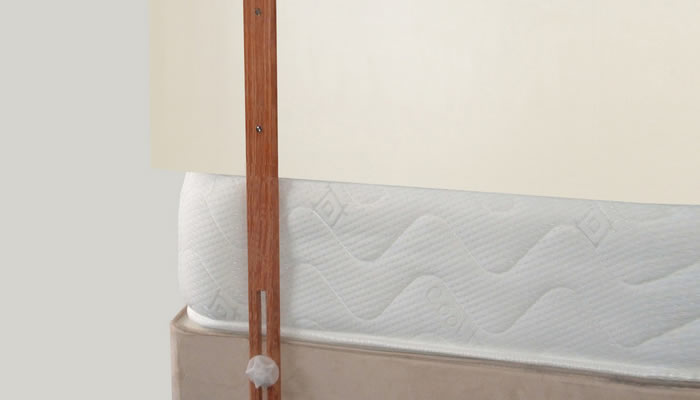
Headboards with struts are the most common form of fitting a headboard to your bed. The struts (wooden thin plank-like objects) are usually sold with your headboard at Bed King. These are shown below on the Vienna headboard.
struts

These struts simply screw into the back of your headboard, whilst the other end will neatly fit onto the back of most standard divan beds. The size of your bed will dictate the size of the headboard you will need to purchase: so a king size 5ft bed will only fit a king-size 5ft headboard. This may seem like obvious information but you would be surprised at the number of people who don’t realise this!
struts on bed
Your divan bed should have two bolts on the back on the back of the divan (most divans include the bolts on both sides so you can decide which way to face your divan). These bolts unscrew, you can then put the headboard in place and then screw the bolts back in place. Some divans hide the screw holes for the bolts underneath the cloth and may not include the bolts.
If there are no bolts in place on the divan, the best thing to do is run your hand across the fabric at the top of the divan base to find the screw holes (usually situated 3 or 4 inches from the end of the divan base and towards the top of the base). If you have misplaced the divan headboard bolts for the headboard, don’t panic, we sell them in our shop.
The struts supplied with most headboards will allow you to slide the headboard up and down the back of the divan depending on how thick your mattress is and how high up you want the headboard to go. Once you’ve found the perfect height you just tighten the bolts on the divan and Ta da! the headboard will hold in place. Take a look at our Skye headboard with struts:
headboard blog 2
Floor standing headboards
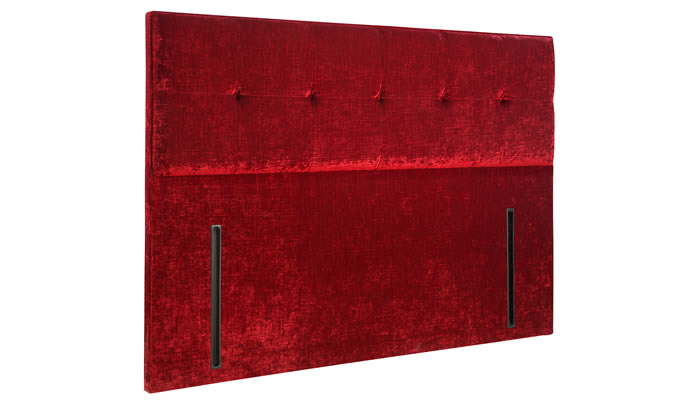
Floor standing headboards are similar to those with struts but operate and look slightly different. Rather than including separate struts, the struts are part of the headboard which will reach down to the floor; this allows the headboard to stand in place behind the bed. In most cases the headboard will include a gap on the standing frame which is where the bolts can be screwed in allowing for a sturdy head end which won’t move about – like the Esher headboard below.
headboard blog 3

Wall-mounted headboards
Wall-mounted headboards or wall hung headboards are usually used for larger headboards which cannot be supported by struts or to make a visual statement. As you can see in the image below, mounting a headboard on your bedroom wall can really make a huge impact in your bedroom.
Wall hung headboards are popular in boutique hotels and should include wall mounting fixings. We always recommend you use a professional DIY expert when fixing your wall hung headboard to the wall, they will ensure the correct tools are used and that your wall will support the headboard you choose.

Top Tips For Fitting Your Headboard

1.)    If your headboard is missing either struts or bolts, don’t panic you can buy them in our headboard accessories shop.
2.)    If you are buying a new divan and plan to fix a headboard to it, ensure it has the screw holes to fit the headboard in place (if you are purchasing a headboard with struts or a floor standing headboard).
3.)    Always use a DIY expert if you plan to wall mount your headboard.
4.)    Get the right fabric and colour before ordering a headboard, use our free fabric sample service.


Article source: https://www.justheadboards.co.uk/blog/2014/10/how-to-fit-a-headboard-to-your-bed/